
The solar physics community lost one of its more innovative scientists when Leif Svalgaard passed away on 11 October, shortly after having been diagnosed with cancer. Born 12 May 1942 in Copenhagen, Denmark, Leif received a B.S. degree in Physics from the University of Copenhagen in 1965 (with an M.S. in Geophysics in 1969) and began working at the Danish Meteorological Institute (DMI) in 1966. His early work with DMI involved application of scientific programming to terrestrial weather mapping and forecasting. His career as a solar-terrestrial physicist began when he was stationed at DMI’s magnetometer station in Godhavn, Greenland in 1967. During his stay there he discovered that the magnetic polarity of the solar wind could be inferred from ground-based magnetometer data, enabling determination of the sector structure of the interplanetary magnetic field (IMF) at 1 AU for many decades prior to the space age. This result, found independently by S.M. Mansurov at about the same time, is now known as the Svalgaard-Mansurov effect.
After a stint as a software developer for the RC4000 computer at Regnecentralen, the first Danish computer company, Leif joined the staff of the Institute for Plasma Research at Stanford University in 1972. His expertise in systems programming and the ALGOL language was instrumental to the rapid development of the Stanford solar group’s computer expertise in a time when memory was costly, operating systems were buggy, and many programs were written in assembly code. He participated in John Wilcox’s team for six years with Tom Duvall, Ken Schatten, Phil Scherrer, and others. During this time Leif made notable contributions to the understanding of the solar sources of large-scale interplanetary magnetic field (IMF) structures in the solar wind and of geomagnetic activity, and he created a valuable catalog of well-defined IMF sector boundaries back to 1926. He investigated the solar polar fields from the newly commissioned Wilcox Solar Observatory at Stanford, leading to recognition of the “precursor” relationship between polar magnetic field strength at solar minimum and the peak sunspot number of the following solar maximum. Other collaborative achievements included determination of the strength and distribution of the Sun’s polar magnetic fields, the recognition of Hale Sector Boundaries in the low corona, the effects of scattered light on measurements of velocity and magnetic field, and the varying rotation rates of large-scale solar and IMF patterns observed over many solar cycles.
After a break from solar physics from1980 to 2000, during which Leif worked in private industry as a software developer, he returned to heliophysics for a second phase of productive research. He was a visiting professor at Nagoya University in 2004 and his primary affiliation after 2009 was the Hansen Experimental Physics Laboratory at Stanford University; during this time his principal collaborators were Frederic Clette, Ed Cliver, Hugh Hudson, Yohsuke Kamide, and Ken Schatten.
From 2001-2010, Leif extended his work of relating geomagnetic observations to solar wind properties by developing two new geomagnetic indices that could be derived from the hourly intensity values of early terrestrial magnetometer records. The InterDiurnal Variability (IDV) index is particularly useful because it is highly correlated with solar wind field strength (B) and essentially independent of solar wind speed (V). The InterHourly Variability (IHV) index is dependent on both B and V. Together these two indices permit estimates of solar wind B and V going back to ~1850. Leif also used the precursor method to predict the low amplitude of Cycle 24 (2008-2019) based on the weak polar field of the preceding minimum.
Leif’s other principal work in this later phase, extending to the time of his death, involved an effort to recalibrate both versions of the sunspot number (SN): (1) Rudolf Wolf’s original time series that considered both spots and groups and (2) the more recent Group SN of Hoyt and Schatten. Leif’s mantra to “Know thy data” and his fluency in German led to his finding in Wolf’s Mittheilungen that the bulk of Wolf’s observations underpinning the original sunspot number series were made with small auxiliary telescopes instead of the standard Fraunhofer refractor in Zurich, contrary to what had been previously assumed. His detailed analysis of original records enabled him to identify idiosyncrasies of individual sunspot observers, the most important of which were Waldmeier’s practice of weighting SN counts by the areas of individual spots and the fundamentally different ways that Wolf and his successor Wolfer counted spots. Leif had a very keen eye for patterns and for inconsistencies, and he was a forceful challenger of the status quo who made many of us reconsider our preconceived assumptions. In large part because of Leif’s probing of the sunspot-number time series, a record which had long been accepted without question, a community-wide effort to recalibrate the sunspot number(s) was initiated in 2013, a process that continues to this day.
We extend our condolences to Leif’s wife Vera and the rest of his family. Leif will be greatly missed by his colleagues for his enthusiasm for studying the Sun and his scientific insight.
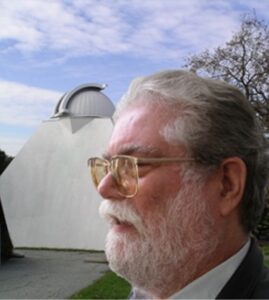
Leif Svalgaard at the Wilcox Solar Observatory
Submitted by J.Todd Hoeksema, Ed Cliver, Frederic Clette, Hugh Hudson, Ken Schatten, and Phil Scherrer