
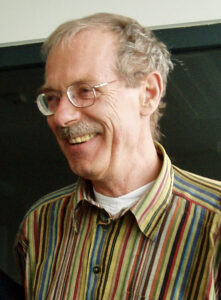
It is with deep sadness that we announce the passing of Prof. Dr. Franz Kneer, an exceptional solar physicist, dedicated mentor, and esteemed colleague whose scientific insight and humanity profoundly shaped many younger solar researchers.
Franz Kneer was born on April 14th, 1943, in Tübingen, Germany. He studied Physics at the Universities of Freiburg and Heidelberg, earning his Diploma in Physics from the University of Freiburg in 1967. He then pursued his doctoral research at the Fraunhofer Institute—today the Institute for Solar Physics (KIS)—and received his PhD from the University of Freiburg in 1970. Franz continued his scientific career at KIS, renamed the Kiepenheuer-Institut für Sonnenphysik in 1975, where he nurtured a lifelong fascination with the dynamics and structure of the solar chromosphere. During this period, he carried out influential work on waves and oscillations in chromospheric layers, advancing our understanding of how energy is transported and dissipated in the Sun’s atmosphere. His studies combined careful observations, theoretical modeling, and deep physical intuition—laying an important foundation for later research on solar atmospheric dynamics.
During a period as a visiting scientist at the High Altitude Observatory of the National Center for Atmospheric Research in Boulder, Colorado, Franz produced one of his early landmark studies: his 1975 Astrophysical Journal paper, ‘Comments on the Redistribution Function of Jefferies and White.’ This work exemplified his characteristic insight into the physics of line formation in stellar atmospheres.
He went on to make major contributions to the theory of solar and stellar chromospheres. His 1980 paper, ‘Time-dependent Ionization in Stellar Chromospheres’, was a pioneering study of non-equilibrium effects in dynamic atmospheres. The physical insights it presented—on how the ionization state of chromospheric plasma lags behind rapid dynamical changes—were years ahead of their time, anticipating the results that would later emerge from sophisticated 3D radiation-MHD simulations. In 1983, he published another remarkable study, ‘A Possible Explanation of the Wilson–Bappu Relation and the Chromospheric Temperature Rise in Late-type Stars’, in which he proposed that molecule formation can trigger temperature-sensitive instabilities in stellar atmospheres, providing a natural explanation for the development of chromospheres in late-type stars.
In 1986, Franz Kneer was appointed Professor of Astrophysics at the University of Göttingen, where he guided the solar physics group of the Universitäts-Sternwarte for nearly three decades. He was also responsible for the Gregory Coudé Telescope at the Observatorio del Teide (Tenerife), which, under his leadership, became a key facility for high-resolution solar observations. Always forward-looking, Franz played a leading role in the development of new instrumentation for solar spectroscopy, culminating in his Fabry–Perot interferometric system for the Vacuum Tower Telescope. This innovative design set new standards for modern imaging spectropolarimetry.
Together with the KIS and the AIP, in 2001 Franz Kneer founded the consortium for the construction of GREGOR, the largest solar telescope in Europe. Under his leadership, important elements of the telescope were also developed and built at the Göttingen Institute.
Franz was also a devoted teacher, advisor, and mentor, having guided many PhD students who went on to distinguished careers in solar and stellar physics. He played an important role in the International Max Planck Research School on Solar Physics (IMPRS) in its early phase. He was also deeply committed to the training of postgraduate students at the European level, taking an active and successful role in the ERASMUS exchange program with the University of La Laguna (Tenerife, Spain) for more than two decades. Franz Kneer inspired those around him not only through his scientific excellence but also through his integrity, patience, and enthusiasm for discovery. His students remember his clarity of thought, his inspiring approach to science, and his warmth, kindness, and generosity. Whether at the telescope, in seminars, or at international meetings, Franz brought together rigor, physical insight, and humor. He embodied the ideal of a scientist whose curiosity was matched by his humanity.
The passing of Franz Kneer is a great loss to our community. His intellectual contributions, his instrumental innovations, and, above all, the many people he trained and inspired ensure that his legacy will continue through the advances and achievements of those who build on his work.
We extend our deepest condolences to his family, friends, students, and colleagues around the world.
—
Nazaret Bello, Juan Manuel Borrero, Javier Trujillo Bueno, and Reiner Volkmer