
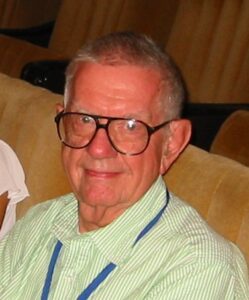
 William Charles Livingston, a gentle and kind man, passed away on May 2, 2026 at age 98. He joined the Solar Division of Kitt Peak National Observatory in 1959 and spent the rest of his research career with that group and its successors. He became Emeritus Astronomer in 1994 and continued to work for another twenty years.
Bill was born on September 13, 1927 in Santa Ana, California. He attended Los Angeles public schools that offered drafting, metal and wood work, electronics, and other manual skills, as well as a traditional curriculum. Bill became interested in astronomy and developed a love of hiking. After one hike to Mt. Wilson Observatory, he walked into the Observatory’s Pasadena office and at age 17 asked for a job. Amazingly, he got a part-time job drafting and working on a wartime project assigned to the observatory. After four months he was drafted into the US Army Air Force and served as a Sergeant from 1945 through 1946. Bill then became an undergraduate at the University of California at Los Angeles and earned a Bachelor’s degree in 1953.
Hired as a Mt. Wilson solar observer in 1950, one of his jobs was to assist Keith Pierce, visiting from McMath-Hulbert Observatory, in mapping the infrared solar spectrum. Bill met many famous visiting astronomers at Mt. Wilson, including Otto Struve, who prompted Bill to become a graduate student at the University of California at Berkeley. There he met Dorothy Newell and they married in 1957. While still a Berkeley grad student, Bill took a two-year leave back to Mt. Wilson to help perfect Horace Babcock’s magnetograph. They were still in residence at Mt. Wilson when he was offered a job from Keith Pierce to come to Tucson to help develop the control system for the McMath solar telescope, then being designed. Bill was awarded his Ph.D. in 1959 and became the first staff astronomer who was not a director of a major program at the Kitt Peak National Observatory (KPNO).
Bill’s thesis work involved developing an image orthicon television camera tube (then used widely in broadcast television) to do stellar photometry. During his first decade at KPNO, Bill continued his development of electronic imaging technology for astronomy. He received an award for television camera design from the Society of Motion Picture and Television Engineers in 1965.
His solar research career from 1959 through 2016 focused mainly on telescope and instrument construction, studies of solar magnetic fields, and 30 years of solar spectrum line variation observations. Of his more than 300 original research publications, more than 95% were with coauthors. His research generosity was shared with more than 230 coauthors from around the world. From 1982 to 1985 Bill served as President of the International Astronomical Union Commission on Instruments and Techniques. He was also a member of the American Astronomical Society, the Astronomical Society of India, and a foreign member of the Norwegian Academy of Science.
Drawing on his Mt. Wilson experience, in 1964 Bill designed and built an improved Babcock-type magnetograph to take advantage of the unequaled light gathering power of the McMath telescope. It featured simultaneous measurements with multiple spectrum lines and vector magnetic field and Doppler velocity measurement capabilities. Visitors and staff used this equipment for numerous research projects including pioneering helioseismology. This first magnetograph was not efficient for full solar disk observations so Bill conceived and developed a second one in 1970 that featured 40 simultaneous spatial channels using fiber optics feeding 80 photomultiplier sensors. This was much more suitable for frequent full-disk observations and was used on a frequent basis to support NASA’s 1973-4 Skylab space station solar observations. NOAA used the observations to help forecast space weather disturbances.
The McMath telescope was serving many research projects and could not be used for daily magnetic observations. So Bill proposed a dedicated 60-cm vacuum solar telescope and magnetograph. With strong support from NASA and KPNO management, the facility was built in record time led by project engineer Dale Schrage. By 1973 linear array sensors with very high sensitivity were available and an instrument with 512 spatial channels was built in 1974 and operated for 19 years. In 1990 this instrument was supplemented with new one led by Harrison Jones that used an area array TV camera sensor vastly improved from Bill’s 1950’s TV work. A valuable archive of daily magnetograms from 1970-2003 is a major part of Bill’s legacy and is still in use. Among the many discoveries with Bill’s magnetographs is his finding of a ubiquitous intranetwork magnetic field on the Sun.
The McMath telescope featured powerful spectrographs to study the details of solar spectrum lines. One of Bill’s discoveries was the presence of water vapor in cold sunspots. His sunspot observations also suggested that the spot magnetic field strength might change strength over time but ultimately disproved this notion. One long term program that Bill started, working closely with O. R. White, was an investigation of how certain spectrum lines varied with solar activity. As part of this program, Bill arranged a way to feed plain sunlight into the spectrographs. This integrated light feed also proved very useful for several helioseismology programs. Another of Bill’s important legacies is his archive of spectrum line profile changes over a 30 year period.
His fascination with optical phenomena in nature led to two editions (co-authored with David Lynch) of “Color and Light in Nature” published by Cambridge University Press and Internet available.
Bill was an adventurer and visited friends and colleagues in Australia, China, Europe, Indonesia, India, Mongolia, and Russia, among others. Many astronomers, students, and engineers from all over the world enjoyed extraordinary hospitality from Bill and his wife Dorothy (who passed three years ago). Their home was the site of legendary parties and conviviality. For those fortunate enough to work with Bill they will remember him as an extraordinary astronomer but especially as a kind and sharing man.
He is survived by his children, Ann and Peter, 5 grandchildren, and 4 great grandchildren.
Submitted by Ann Feicht, Jack Harvey, Peter Livingston