
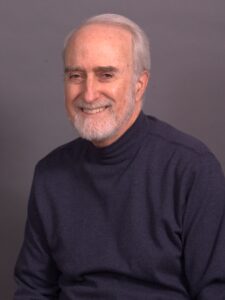
Thomas “Tom” Holzer, a pioneering solar physicist and former director of the High Altitude Observatory (HAO) at NCAR, passed away peacefully on August 28, 2025.
Born in Albuquerque, NM, and raised in Los Angeles, Tom was the youngest of three siblings. He earned his B.A. in physics from Pomona College in 1965 and his Ph.D. in applied physics from the University of California, San Diego in 1970, where he studied space physics and astrophysics under Peter Banks and Ian Axford. His thesis provided key theoretical support for Axford’s postulation of the “polar wind,” an outward flow of thermal particles from the regions surrounding Earth’s magnetic poles.
Following his Ph.D., Tom spent a year at Imperial College London as a researcher with James Dungey. He then moved to Boulder, Colorado, for a National Research Council fellowship at NOAA’s Aeronomy Laboratory, collaborating with George Reid on theoretical models of the magnetosphere-ionosphere system. In 1973, Tom joined NCAR’s High Altitude Observatory, where he would remain for the rest of his 33-year research career.
Tom’s early work focused on the general theory of stellar and solar wind flows, the interaction of the solar wind with interstellar matter, the expansion of the polar ionosphere to form the polar wind, and the coupling between the solar wind, magnetosphere, and ionosphere. His research combined theory and observations to unravel the physical processes that accelerate the solar wind and shape the solar corona.
In recognition of his groundbreaking contributions, Tom was elected as a Fellow of the American Geophysical Union (AGU) and received the AGU James B. Macelwane Award in 1978 for “a thorough understanding of basic physics along with a broad outlook that has enabled him to view his own work in the wider context of geophysics and astrophysics.” He was later elected to the Norwegian Academy of Science and Letters in 1995.
Tom became HAO Director in 1990, a decision that colleagues described as courageous: “Tom set out to reform the NCAR/UCAR institutional and scientific culture, believing that a good scientist should always have a go at it.” As Director, Tom strengthened HAO’s scientific reach, including integrating CU Boulder’s solar radiation group into HAO and increasing the lab’s research capacity by 30%. He championed the idea that scientists themselves should discover and define what is “truly significant and worth investigating,” trusting in intellectual curiosity as the driver of scientific advancement.
Even after stepping down as Director, Tom remained a steady and influential presence at HAO and within the broader solar physics community. He led HAO’s coronal group and was a dedicated supporter of the Mauna Loa Solar Observatory. Under his leadership, unique solar data were made widely available, fueling groundbreaking research across multiple fields. Tom’s mentorship left a deep impression on many in the group, including Holly Gilbert, with whom he collaborated on influential work exploring ion-neutral coupling in the solar chromosphere and solar prominences. His kindness and genuine care for those around him built collaborative relationships that extended beyond science—something Holly feels fortunate to have experienced firsthand.
In addition to being a generous mentor, Tom was a deeply valued collaborator. Colleague Egil Leer recalled that working with Tom inspired decades of fruitful research: “Tom taught me to push our theoretical models to better understand the physics of the systems we studied.” Many students and postdocs from Norway and beyond benefited from his guidance, and his collaborations led to advances in modeling the solar wind and understanding the solar corona.
Beyond science, Tom was a devoted husband to his wife, Cathie, and an active member of the Boulder community. He enjoyed golf, pool, and bridge, and volunteered with the Senior Peer Counseling Program through Mental Health Partners of Boulder County.
Tom’s impact on solar physics and the HAO community was profound, but his greatest legacy may be the intellectual curiosity and collaborative spirit he inspired in those who worked with him. He will be remembered as a scientist of vision, a leader of integrity, and a friend and mentor whose influence will continue to shape the field for years to come.
Holly Gilbert, Bob MacQueen, Egil Leer, BC Low, Scott McIntosh