
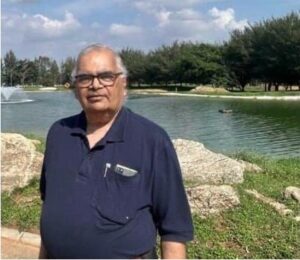
The global scientific community mourns the loss of Professor Parameswaran Venkatakrishnan, a pioneer in solar physics, who passed away suddenly on 12 April 2025, at the age of 72. His final rites were held on 14 April in Bengaluru, Karnataka, India.
Known affectionately as “Venkat” to colleagues and students, Prof. Venkatakrishnan was a cornerstone of solar physics research in India. Born in Thiruvananthapuram in 1953, he excelled academically from an early age, earning top ranks in his BSc and MSc in Physics at University College, Thiruvananthapuram. He joined the Indian Institute of Astrophysics (IIA) in 1974 and completed his Ph.D in 1984, with a focus on convection and magnetic fields in the Sun. He had a long career at the IIA from 1974 to 1999, reaching the position of Professor. From 1999 to 2015, he served as Senior Professor and Head of the Udaipur Solar Observatory (USO), where he led numerous groundbreaking initiatives that elevated India’s standing in solar research.
Over a distinguished career spanning four decades, he published more than 100 peer-reviewed articles, served on the editorial board of the journal Solar Physics, and he was actively involved with the International Astronomical Union. He mentored 13 Ph.D. students, nurturing a generation of solar physicists who now carry forward his legacy at leading national and international institutions.
As Head of the Udaipur Solar Observatory (1999 – 2015), he led it to become a hub of cutting-edge solar instrumentation. He led the development of India’s first high-resolution solar telescope, the 50 cm Multi-Application Solar Telescope (MAST), located on an island in Lake Fatehsagar. His efforts were recognized with the ISRO Team Award.
He was also a pioneer in adopting advanced observational techniques such as adaptive optics and interferometry, including successful Fizeau Mask Interferometry using MAST. His 1986 Nature publication, predicting the inhibition of convective collapse in slender magnetic flux tubes, remains a landmark in solar magnetic field theory.
Prof. Venkatakrishnan played a pivotal role in shaping India’s space-based solar research programs. He was an early contributor to the roadmap that led to Aditya-L1, India’s first dedicated solar mission, now operational at the L1 point. He served on multiple ISRO committees, including those under the Advisory Committee for Space Sciences (ADCOS), and remained active in mission reviews even after retirement.
Even in retirement, he remained deeply engaged with the field. Between 2018 and 2020, he served as Visiting Professor at the U R Rao Satellite Centre, contributing to the Aditya-L1 mission. He also wrote three popular science books aimed at engaging the public with the wonders of solar physics: Our Daytime Star: A Brief History of the Sun, The Amazing Story of Kuton the Photon, and Off to an Eclipse.
Above all, Prof. Venkatakrishnan will be remembered for his humility, accessibility, and commitment to mentoring young scientists. He was a thoughtful listener, never imposing his views, but always ready with encouragement and guidance.
He is survived by his loving wife and two sons. His warmth, intellectual rigor, and vision made a lasting impression on all who knew him.
—
Indian Institute of Astrophysics, Bengaluru, India and Udaipur Solar Observatory/Physical Research Laboratory, Udaipur, India.